
One gathering.
Many screens.
Create a shared light experience with the phones people already carry. A host schedules the show. Guests join an invitation and their screens become lights in one coordinated scene.
Organized events
Use one rectangular block of rows and seats. Guests confirm their organizer-assigned seat. Aura checks duplicates and remembers placement for rejoin. Shared programs render locally against the event timeline.
Free crowds
Start with shared colors and interactive moments without a seat map. Experimental LightMap uses the host camera to measure visible stationary phones for Mosaic. Moving crowds need fresh measurement; arrival order is not a physical position.
Timing, participation and placement together
Create and invite
Hosts sign in and create an event. Guests join its invitation anonymously. Nearby discovery is available with a native advertising host and Bluetooth permissions.
Calibrate and schedule
Phones estimate server time. Commands are scheduled ahead and effects render locally. Clock uncertainty is visible; it does not measure physical screen-to-screen skew.
Interact and recover
Recipient-specific spark catches are confirmed by the server. Persisted event state and remembered placement support reconnects. Hosts can stop or blackout the show.
Rehearse and measure
Test the intended devices, network, brightness and duration before an event. Use physical observations to evaluate visible timing and battery cost.
A working pilot, with explicit limits
The records establish implemented workflows and software checks. They do not establish stadium capacity, precise BLE positioning or guaranteed synchronization.
Recorded checks
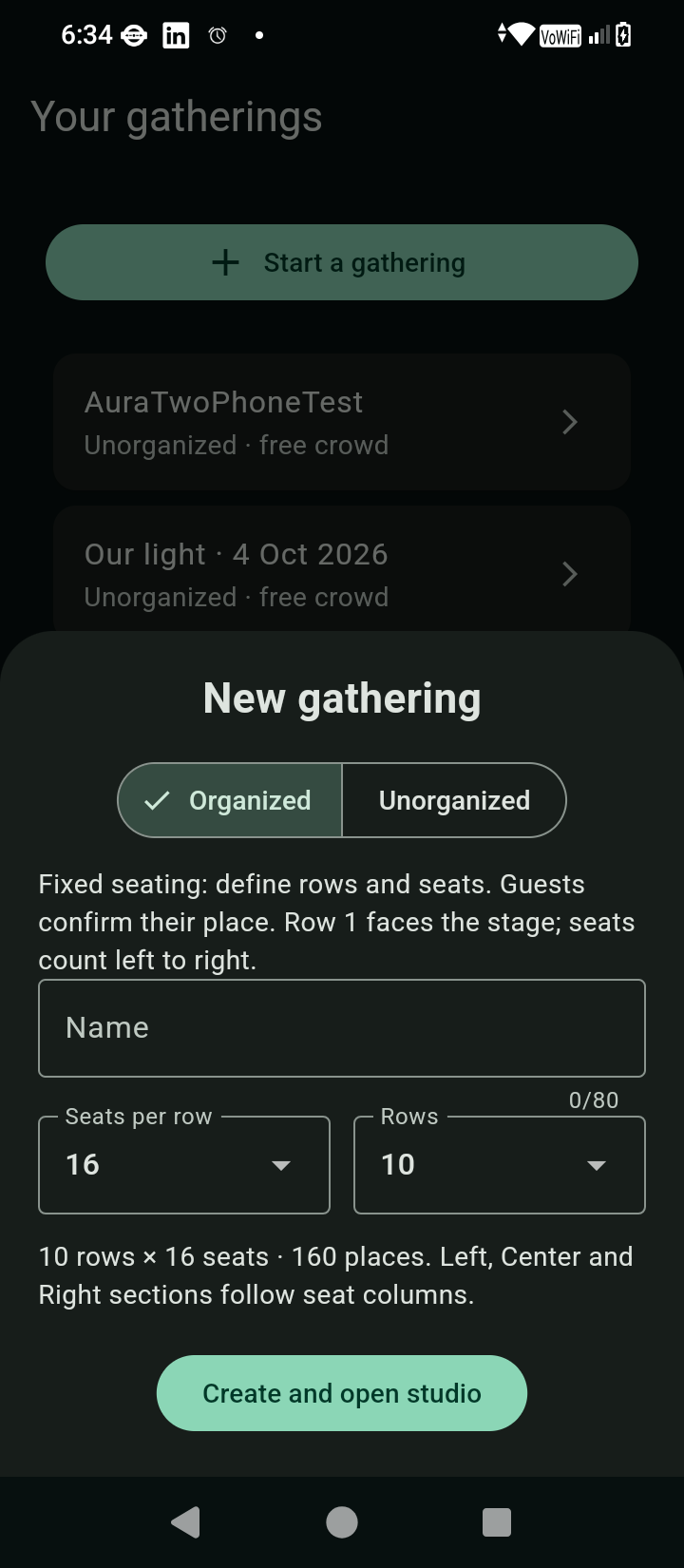
The September Spark release records a 24-client simulated interaction scenario and nine checks with three live guest browser contexts. The October 2.3.0 release records backend, native and renderer checks, duplicate-seat rejection, remembered-seat rejoin and the free-crowd Mosaic guard. Creation screens were reviewed on one USB phone.
Synthetic clients are not a physical crowd trial.
Current boundaries
512 seats/slots is an allocation limit, not verified simultaneous audience capacity. The pilot uses one API process. Optical mapping and BLE sensing are experimental. BLE summaries describe neighbor evidence, not exact distance, secure presence or moving-device trajectories. Arbitrary uploaded image/video mosaics remain future work.
Implemented Android controls
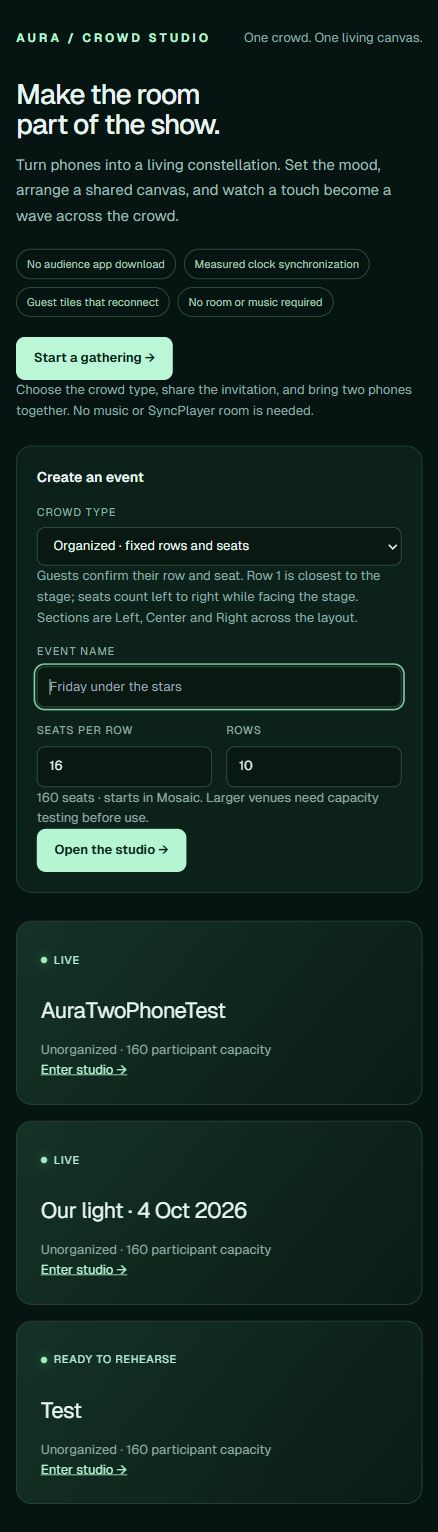
Aura 2.3.0 screens captured on 7 October 2026. Interface evidence, rather than a claim about audience scale.
Plan a measured pilot
Talk with the team about your layout, phone mix, network and event duration. Optional Spatial Lab experiments require separate sensing and recording consent.